Zega Apparel — Vertically integrated custom clothing manufacturer since 2012
MOQ 200 units / style AQL 2.5 inspection Shipping to 30+ countries
0%

Private Label Denim Jeans Manufacturing demands more than selecting a fashionable wash and adding a woven label. It requires careful decisions from fabric sourcing to final inspection. A reliable production plan begins with clear measurements, tested denim, and realistic cost targets. Small details matter. Pocket placement can change the entire appearance of a pair of jeans. Stitch tension can affect durability after repeated washing. Even the shade of indigo may vary between production batches.

In practical factory work, I have seen promising samples fail because the fit was not graded correctly. I have also seen attractive prices hide weak quality control, delayed communication, or inconsistent fabric sourcing. No factory is flawless. That is why supplier evaluation should include production records, sample reviews, factory communication, and documented inspections. Certifications can support trust, but they should be verified rather than accepted blindly. A polished presentation proves little.

This guide presents ten practical tips for building a more dependable denim program. It covers fabric weight, stretch recovery, pattern development, wash testing, labeling, packaging, and pre-shipment checks. Each stage affects the customer’s experience. A rigid waistband can create complaints. An uneven hem can damage a carefully built brand image. A responsible manufacturer also considers worker safety, traceable materials, and applicable product requirements in target markets.

Details decide outcomes.

The process will not always be perfect. Samples may need revision. Timelines may shift. Honest feedback and documented decisions make those problems manageable. With disciplined planning, Private Label Denim Jeans Manufacturing can become a repeatable process instead of a costly experiment.

10 Tips for Private Label Denim Jeans Manufacturing

Defining Your Private Label Denim Jeans Product Concept

Defining a private label denim jeans concept starts with the wearer, not the wash chart. Specify the customer’s age, lifestyle, climate, body preferences, and daily movement. A commuter may need stretch recovery, while a warehouse worker may value reinforced pockets. Textile Exchange’s Materials Market Report 2024 estimates global fiber production reached 124 million tonnes in 2023. It may reach 160 million tonnes by 2030. That scale makes material selection a serious product decision.

Choose the fabric weight, fiber blend, rise, leg shape, hardware, stitching, and wash together. A 12-ounce cotton denim can feel structured, but it may feel uncomfortable in humid weather. Stretch can improve mobility, yet excessive elastane may complicate recycling. The Ellen MacArthur Foundation’s Jeans Redesign guidelines emphasize durability, material health, recyclability, and easier disassembly. Treat these principles as development tools, not decoration. Small details matter. A pocket opening can fail during fitting.

Build a measurable first sample. Record shrinkage after washing, colorfastness, seam strength, and recovery after repeated wear. WRAP’s Valuing Our Clothes report suggests that extending a garment’s active life by nine months can reduce its carbon, water, and waste footprints by around 20–30 percent. That supports designing for longer use, not only visual appeal. A common mistake is approving a beautiful sample before testing movement. The concept may still be wrong. Ask for wear trials across several body types, then revise the fit, fabric, or construction without defending the original idea.

Fabric weight is one of the first decisions in defining a private label denim jeans product concept. Common denim specifications range from approximately 8 oz/yd² for lightweight jeans to 16 oz/yd² for heavyweight styles. Midweight denim between 10 and 12 oz/yd² is widely used for versatile, year-round products.

Selecting Fabrics, Washes, Fits, and Custom Design Details

Private label denim begins with the fabric, not the label. Choose cotton blends according to stretch, recovery, weight, and season. A 10-ounce denim may feel comfortable, while a heavier 13-ounce fabric offers stronger structure. Ask the mill for composition reports, shrinkage tests, and colorfastness results. I always wash a sample before approving bulk fabric. Measurements can change after laundering.

Tip 1: Match fabric stretch to the intended fit. Too much elastane may create knee bags after repeated wear. Too little stretch can make slim jeans uncomfortable. Test sitting, walking, and bending, not only standing.

Washes define the garment’s character. Stone washing creates softness, while enzyme washing can produce a cleaner, lighter surface. Inspect whiskers, fading, and pocket contrast under natural light. The same recipe may look different on black, indigo, and gray denim. Keep approved wash samples for production comparison. Wash development is rarely perfect on the first attempt.

Tip 2: Confirm fit through several sample rounds. Check the rise, hip balance, thigh width, inseam, and leg opening. A minor rise adjustment can change the entire silhouette. Use real movement tests and record every correction clearly.

Custom details should support function. Consider branded buttons, reinforced belt loops, pocket shapes, embroidery, and interior labels. Check sharp edges, loose threads, and uneven stitching before approval. Tip 3: Build a written measurement chart with tolerances. I have learned that “close enough” often causes costly rework. Reliable production depends on clear specifications, tested samples, and honest inspection records.

10 Tips for Private Label Denim Jeans Manufacturing - Selecting Fabrics, Washes, Fits, and Custom Design Details
Tip Manufacturing Dimension Recommended Parameters and Real-World Data Key Quality-Control Checks Common Risk to Manage Best Use or Design Effect
1 Select the Appropriate Denim Weight Use 8–10 oz denim for lightweight jeans, 10–12.5 oz for versatile everyday styles, and 13–16 oz for rigid workwear or heritage-inspired products. Denim weight is commonly measured in ounces per square yard. Confirm fabric weight within the approved tolerance, typically approximately ±5%. Check thickness, hand feel, width, and shade consistency across the roll. Heavy denim can feel stiff and restrict movement, while lightweight denim may show pocketing, seam impressions, or faster wear. Medium-weight denim is a practical starting point for year-round five-pocket jeans and most commercial fits.
2 Choose Fiber Composition Carefully Rigid jeans may use 100% cotton. Comfort-stretch denim commonly contains about 1–2% elastane, while higher-stretch constructions may use approximately 2–3% elastane. Cotton-polyester blends can improve dimensional stability and abrasion resistance. Verify fiber content through supplier documentation and laboratory testing. Measure stretch and recovery after repeated extension cycles and laundering. Excessive elastane or poor recovery can lead to bagging at the knees, waistband growth, and loss of the original silhouette. Use low-stretch denim for a structured vintage look and moderate stretch for fitted silhouettes requiring daily comfort.
3 Match Fabric Construction to the Fit Choose right-hand twill, left-hand twill, or broken twill according to the desired surface character. Broken twill can help reduce leg twisting, while stretch denim should be evaluated with the intended pattern and seam construction. Test the fabric on the complete garment, checking mobility, seam torque, leg twisting, pocket opening, and recovery at the seat and knees. A fabric that performs well on a flat swatch may behave differently after cutting, sewing, washing, and pressing. Use the final garment prototype—not only the fabric roll—for fit approval and performance decisions.
4 Define the Silhouette with Measurable Points Specify waist, hip, front rise, back rise, thigh, knee, hem opening, inseam, and outseam measurements. A straight leg usually maintains a relatively consistent leg width, while a tapered leg narrows toward the hem. Create a graded measurement chart with tolerances, commonly around ±0.5–1.0 cm depending on the measurement point and product requirements. Terms such as “relaxed,” “slim,” or “wide” can be interpreted differently without a technical measurement chart and approved fit sample. Use a signed specification sheet and fit comments for every size before bulk production begins.
5 Plan Shrinkage Before Pattern Finalization Sanforized denim is mechanically pre-shrunk, but residual shrinkage still varies by fabric and wash. Rigid or untreated denim generally requires more careful shrinkage planning than pre-washed denim. Record lengthwise and widthwise shrinkage after the intended wash process. Conduct at least one wash test using the final fabric, trims, thread, and construction. Uncontrolled shrinkage can change inseam length, waistband circumference, rise balance, and overall proportions. Approve the post-wash measurement chart rather than relying only on the pre-wash pattern dimensions.
6 Select Washes by Intended Appearance Common denim processes include rinse wash, stone wash, enzyme wash, bleach wash, tinting, and vintage abrasion effects. Rinse washing produces a cleaner, darker appearance, while stone or enzyme treatments create a softer and more worn surface. Approve a physical wash standard and compare color, softness, contrast, whiskers, hand scraping, and overall cast under consistent lighting. Wash results can vary because of liquor ratio, temperature, time, chemical concentration, load size, and machine action. Use rinse or light enzyme washes for a clean commercial look and stronger abrasion effects for vintage or distressed collections.
7 Control Colorfastness and Crocking Indigo and sulfur-dyed denim can transfer color through wet or dry crocking, especially on dark shades. Colorfastness requirements should be agreed using recognized test methods and the destination market’s regulations. Test colorfastness to washing, rubbing, perspiration, and light as appropriate. Inspect pocketing, labels, thread, and adjacent panels for staining or shade migration. Poor wet rubbing or washing fastness may cause transfer onto light garments, upholstery, footwear, or skin. Dark indigo styles should receive particularly careful crocking and wash-fastness approval before shipment.
8 Engineer Seams and Reinforcement Points Use durable lockstitch or chainstitch construction as appropriate, with reinforced stress points such as belt-loop attachments, pocket corners, fly areas, and crotch seams. Bartacks are commonly applied at high-load locations. Check stitch density, skipped stitches, seam allowance, bartack placement, thread tension, zipper operation, and seam strength through wear or load testing. High abrasion from washing and wear can expose weak thread, open pocket corners, or cause crotch and seat seam failures. Reinforce areas according to the intended use: fashion wear, daily casual wear, or workwear requires different durability priorities.
9 Customize Hardware and Branding Details Define button, rivet, zipper, patch, label, thread, and pocket-stitch specifications. Common hardware materials include zinc alloy, brass, stainless steel, and coated metal; the final choice should reflect appearance and corrosion requirements. Check plating or coating adhesion, sharp edges, corrosion resistance, pull strength, zipper function, rivet security, label placement, and artwork accuracy. Incorrect hardware dimensions can affect buttonhole fit, waistband construction, wash appearance, or wearer safety. Keep custom details consistent across all sizes and document exact placement from approved reference points.
10 Use a Complete Pre-Production Approval Process Approve the fabric, color standard, pattern, graded size set, construction sample, wash sample, trims, packaging, and final measurement chart before bulk cutting. Inspect bulk fabric before cutting, establish an acceptable quality limit, perform inline and final inspections, and retain a sealed reference sample for comparison. Changing fabric, wash, trims, or pattern after approval can create inconsistent lots, unexpected costs, and delivery delays. A documented approval trail reduces variation and makes private label production easier to repeat across future seasons.

Evaluating and Choosing a Reliable Denim Manufacturer

10 Tips for Private Label Denim Jeans Manufacturing

Evaluating and Choosing a Reliable Denim Manufacturer

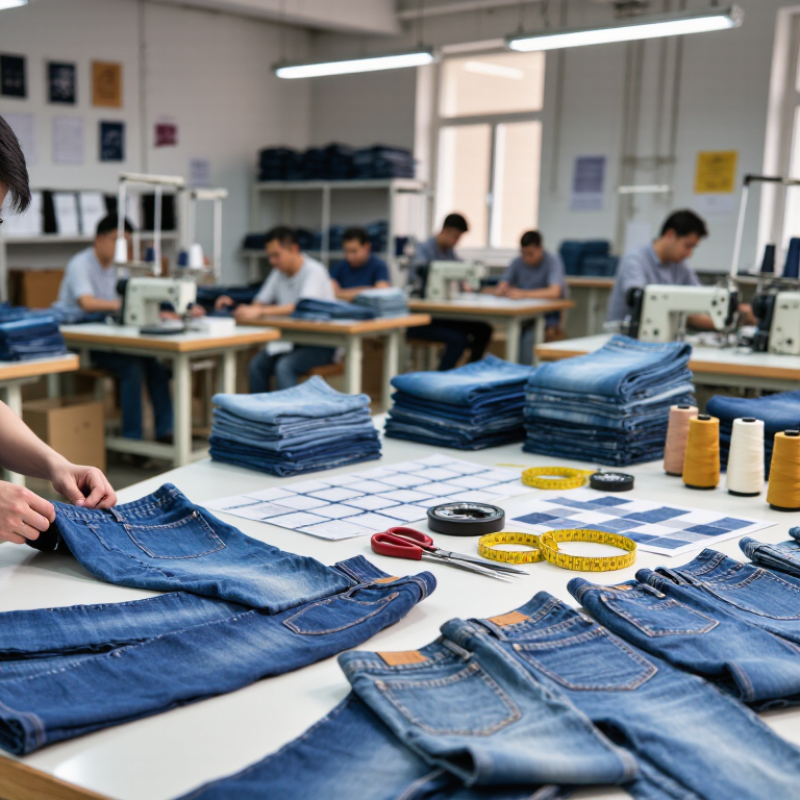
A reliable denim manufacturer should prove capability before discussing large orders. Request recent production samples, not only polished showroom pieces. Check stitch density, pocket alignment, seam strength, zipper movement, and shrinkage after washing. Small details reveal factory discipline. Ask who controls fabric inspection and final measurements. Experienced teams should explain their process clearly, without hiding behind vague promises.

Tip: Visit the production floor when possible. Observe cutting tables, sewing lines, pressing areas, and finished-goods storage. A clean facility does not guarantee quality, but disorganized records often signal future problems. Request a sample inspection report, material composition details, and realistic lead times. Confirm minimum order quantities and whether the factory can repeat approved measurements. Consistency matters more than one impressive sample.

Tip: Test communication before signing. Send a detailed tech pack and compare the manufacturer’s questions. Useful questions usually cover fit, fabric weight, wash effects, hardware, packaging, and tolerances. Silence may feel convenient, but it creates expensive misunderstandings later. I have seen buyers focus heavily on price and overlook development delays. That judgment is understandable, yet incomplete. A cheaper quotation can become costly after rejected samples, rework, or missed delivery windows.

Use a written approval system for fabric, color, measurements, labels, and washing results. Require updates at agreed production stages. Choose a partner willing to discuss mistakes openly and correct them with documented actions. Reliability is not perfection. It is visible control, honest communication, and repeatable performance.

Managing Samples, Quality Standards, and Production Approvals

Private label denim manufacturing becomes reliable when sample control starts early.

Share a complete tech pack with measurements, fabric weight, stretch percentage, stitching, hardware, and wash effects. Keep one approved reference sample in the factory and one in your office. Label both clearly.

Test the denim before bulk cutting. Check shrinkage after washing, color transfer, seam strength, and pocket placement. A 12-ounce fabric may feel firm before washing, then soften noticeably. Record every result.

Use a measurement chart with clear tolerances, such as plus or minus 0.5 centimeters. Vague standards create avoidable disputes. They also weaken production control.

Review the development sample on a real body, not only a table. Check waistband comfort, rise balance, knee shape, and hem appearance. Approve a pre-production sample before cutting the full order. During sewing, inspect the first pieces from each production line. Watch thread tension, bartacks, rivets, and label positions. Request photos of critical operations. A mid-production inspection can reveal problems earlier. Perform a final inspection after washing, pressing, and packing.

Do not approve color from a phone image. Lighting changes everything. Use physical swatches and agreed light conditions. Keep written approval records with dates and comments. I have seen teams approve a sample too quickly, then regret missing a one-centimeter rise difference. That mistake is useful, but expensive. Leave time for one correction cycle. Perfect plans rarely survive real production. Clear checkpoints make the imperfections manageable.

Planning Costs, Orders, Packaging, and Delivery Requirements

Tip 1: Build a cost sheet before contacting a factory. Include denim fabric, trims, stitching, washing, labels, packaging, inspection, freight, and taxes.

Tip 2: Request prices at several order quantities. A lower unit cost may create excessive inventory.

Tip 3: Keep a contingency budget for sampling changes and fabric waste. Real planning is rarely perfect.

Tip 4: Define your order quantity by size and color. Factories need a clear breakdown, not only a total number.

Tip 5: Confirm the minimum order quantity in writing.

Tip 6: Approve a physical sample before bulk production. Check waistband tension, pocket strength, zipper movement, and shrinkage after washing.

Tip 7: Select packaging that protects folded jeans from moisture and dust. Individual bags, carton dividers, and carton labels can reduce warehouse confusion.

Tip 8: Avoid oversized cartons. They increase shipping volume and may crush garments underneath.

Tip 9: Agree on delivery terms, production dates, inspection timing, and shipping documents before placing the order. Allow extra days for washing or rework. Delays happen.

Tip 10: Use a pre-shipment checklist with measurements, color shades, carton counts, and packing photos. I once treated the estimated delivery date as fixed; that assumption caused unnecessary pressure. Leave room for port changes, holidays, and corrective work.

FAQS

How can I evaluate a denim manufacturer before placing a large order?

Request recent production samples, not only polished showroom pieces. Check stitch density, pocket alignment, seam strength, zipper movement, and wash shrinkage. Small details matter. Ask who controls fabric inspection and final measurements. Consistency matters more than one impressive sample.

Should I visit the production facility?

Visit when possible. Observe cutting tables, sewing lines, pressing areas, and finished-goods storage. A clean facility helps, but it does not guarantee quality. Disorganized records may signal future problems. Request inspection reports, material details, and realistic lead times.

What should I include in a denim tech pack?

Include measurements, fabric weight, stretch percentage, stitching, hardware, labels, packaging, and wash effects. Add clear tolerances, such as plus or minus 0.5 centimeters. Vague standards create disputes. Add size-and-color order quantities too.

How should I control samples and approvals?

Keep one approved reference sample at the factory and another in your office. Label both clearly. Approve fabric, color, measurements, labels, and washing results in writing. Keep dates and comments. Leave time for one correction cycle.

What tests should denim undergo before bulk cutting?

Test shrinkage after washing, color transfer, seam strength, and pocket placement. Check waistband comfort, rise balance, knee shape, and hem appearance on a real body. A 12-ounce fabric may soften after washing. Record every result.

How can I avoid quality problems during production?

Inspect the first pieces from each sewing line. Check thread tension, bartacks, rivets, and label positions. Request photos of critical operations. Conduct a mid-production inspection. Complete a final inspection after washing, pressing, and packing.

What costs should a denim production budget include?

Include fabric, trims, stitching, washing, labels, packaging, inspection, freight, and taxes. Request prices at several order quantities. Keep a contingency budget for sample changes and fabric waste. A cheaper quotation can become costly after rework.

What delivery and packaging details need written confirmation?

Confirm minimum quantities, production dates, inspection timing, delivery terms, and shipping documents. Use packaging that protects folded jeans from dust and moisture. Avoid oversized cartons. Use carton dividers, labels, and packing photos. Delays happen. Leave room for holidays, port changes, and corrective work.

Conclusion

Private Label Denim Jeans Manufacturing begins with a clear product concept that defines your target customer, style direction, price position, and seasonal goals. Carefully select denim fabrics, washes, fits, colors, trims, stitching, hardware, and other custom design details to create a consistent and market-ready product. A reliable manufacturer should be evaluated through communication, technical expertise, production capacity, workmanship, transparency, and the ability to meet your specifications.

Effective planning is equally important throughout development and production. Review samples thoroughly, establish measurable quality standards, and approve fit, construction, color, and finishing details before bulk manufacturing begins. Build a realistic budget that includes materials, sampling, labor, packaging, shipping, and potential adjustments. Confirm minimum order quantities, production schedules, packaging requirements, labeling specifications, inspection procedures, and delivery arrangements in advance. Clear documentation and regular communication can reduce costly mistakes, improve consistency, and help ensure that the final denim jeans meet both customer expectations and business objectives.

Amelia

Amelia

Amelia is a dedicated marketing professional with a strong understanding of the company’s products, services, and long-term business goals. Through thoughtful research and clear communication, she helps customers discover practical solutions that support efficiency, reliability, and sustainable......