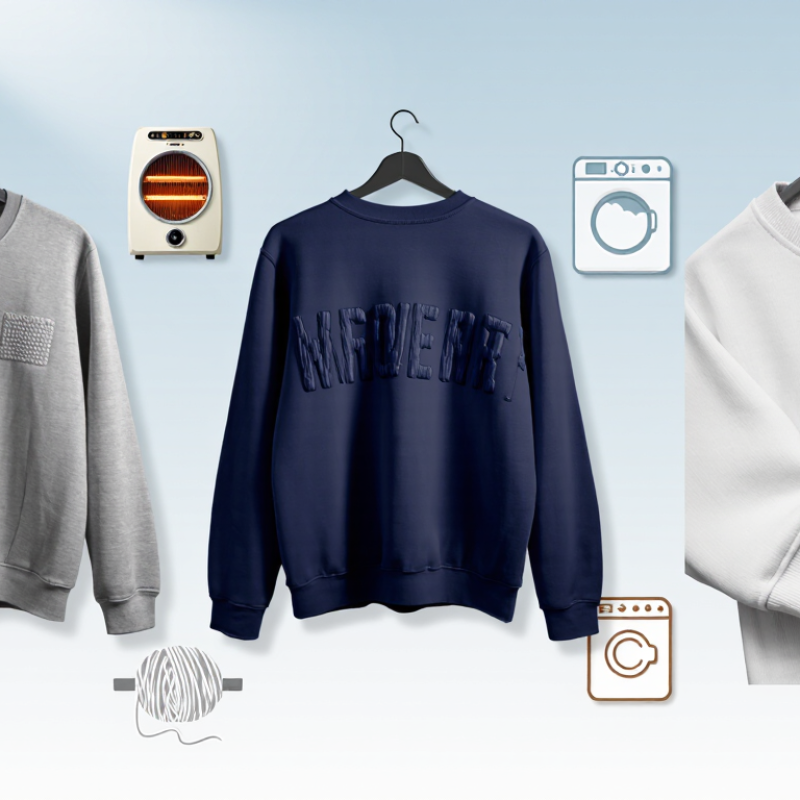
Custom Puff Print Sweatshirts use a raised printing technique to give selected parts of a design a soft, dimensional finish. The ink expands with heat, creating a textured surface that stands above the fabric. Texture matters. A small logo on the chest can feel subtle, while large lettering across the back creates a bolder look. The final effect depends on the artwork, ink, fabric, and production settings.
This guide explains how puff printing works and what to consider before ordering. Fabric choice is important: a stable cotton or cotton-blend sweatshirt often provides a suitable surface, but results vary by garment and supplier. Ask for a sample when possible. Check the print’s height, softness, and edges, then follow the care instructions and wash-test a sample if durability is a priority. Heat, stretch, and repeated washing may affect the raised finish over time. That detail is easy to overlook.
Custom Puff Print Sweatshirts can suit team apparel, merchandise, and personal designs, but the technique is not ideal for every graphic. Very fine lines or crowded artwork may lose clarity when raised ink expands. A simpler design often reads better. Still, there is no universal formula; colors and textures can look different under indoor lighting or on another fabric shade. Reviewing a physical sample helps set realistic expectations before a larger order.
Custom puff print sweatshirts use specialty ink that expands when heated, creating a raised, soft design on the fabric. The effect can make letters feel almost cushioned under your fingertips. It works well for bold text, simple shapes, and designs with open space. Tiny details may blur or lose definition as the ink rises. That trade-off matters.
The process usually involves preparing artwork, printing a puff-ink layer, and curing it with controlled heat. Fabric type, ink thickness, and curing conditions all affect the final texture. Cotton-rich fleece often provides a stable surface, though testing a sample before a full run is wise.
The print should feel evenly raised, not brittle or sticky. Check its edges and stretch, then wash the sample to see how it holds up. Turning a sweatshirt inside out and using a cool wash can reduce friction.
Puff print can look striking, yet it is not right for every design. Sometimes a flatter print is simply clearer.
Custom puff print sweatshirts feature raised graphics made with specialized printing ink. The ink expands under controlled heat, creating a soft, foam-like surface above the fabric. The effect can feel gently cushioned, not rigid. Print height depends on the ink formula, screen deposit, and curing conditions. Too much heat or ink may flatten details or produce an uneven, brittle surface.
The sweatshirt fabric affects both comfort and print quality. Many styles use knitted fleece, with a smooth outer face for printing and a brushed inner surface for warmth. Cotton can provide a soft hand, while polyester often supports shape retention and quicker drying; blended fabrics combine some of these traits. Textile Exchange’s Materials Market Report 2024 estimates that global fiber production reached 124 million tonnes in 2023, with polyester representing 57 percent. That figure describes the wider textile market, not sweatshirt production, but it shows why fiber choice matters at scale.
During construction, the garment is usually stabilized before printing so the design sits evenly across the chest or sleeve. The ink layer needs enough space to expand without filling small lettering. Test prints help reveal cracking, poor adhesion, or a print that feels too heavy. There is a trade-off. A taller effect may look striking, yet it can reduce fine detail and flexibility. Fabric weight, fleece texture, and wash care can all change the final feel, so samples deserve close inspection.
Custom puff print sweatshirts get their raised look from ink that expands under controlled heat. The design usually begins as artwork prepared for screen printing. A thicker puff additive is mixed into the ink, then applied through a screen onto the sweatshirt. The print may look fairly flat at this stage. That is normal.
Heat activates the additive and makes the printed layer swell. As it expands, the surface develops a soft, rounded texture you can feel with your fingertips. The printer must balance temperature, pressure, and curing time. Too little heat can leave the design under-expanded; too much may flatten it or affect the fabric. Results also depend on the sweatshirt’s material and the size of the printed areas. Small letters can fill in, while very broad shapes may puff unevenly. It is a detail worth testing.
After curing, the print should feel raised without appearing brittle or loose. A careful maker checks the finish and follows the garment’s care instructions, since repeated high heat and rough washing can wear down printed surfaces. Puff printing is not perfectly uniform every time, and that slight variation can be noticeable. A sample wash helps reveal how the texture holds up before a larger run.
Puff printing uses heat-reactive ink that expands during curing, creating a raised design. The chart converts Celsius temperatures to Fahrenheit; it is a conversion reference, not a recommended curing range. Follow the ink manufacturer’s instructions for specific settings.
Custom puff-print sweatshirts use heat-applied ink that expands into a raised surface. Common designs include bold chest lettering, compact sleeve symbols, outlined illustrations, and large back graphics. A tonal print can feel subtle; bright ink makes the texture more noticeable. Some designs combine flat ink with raised details. Keep fine lines and tiny text limited: they may lose definition, and dense artwork can feel stiff. Test the artwork on the actual sweatshirt fabric before production. A sample matters.
Design choices should match the intended use. Club apparel, event crews, school groups, and small-run merchandise often benefit from readable graphics and clear placement. Grand View Research’s Custom T-shirt Printing Market report valued that broader market at about $4.31 billion in 2022 and projected 11.1% annual growth through 2030. It measures printed T-shirts, not puff-print sweatshirts, so it signals demand for customization rather than this technique specifically. McKinsey and The Business of Fashion’s State of Fashion 2024 projected 2–4% global fashion sales growth that year. In a crowded apparel market, distinctive texture may help a garment stand out. But more texture is not always better. Raised print can feel awkward under a backpack strap or across a heavily folded seam. Use it selectively, and check comfort after washing.
| Design Option | What It Looks Like | Design Considerations | Common Uses |
|---|---|---|---|
| Raised lettering | Text stands above the fabric with a soft, rounded, three-dimensional finish. | Bold lettering is generally easier to read than very small or tightly spaced text. A sample helps confirm the final height and legibility. | College-inspired designs, team names, event apparel, and simple slogan sweatshirts. |
| Large graphic or logo-style artwork | A prominent raised shape or graphic creates a tactile focal point on the front or back. | Broad shapes with clear outlines tend to suit the raised effect. Fine lines and intricate details may not reproduce as clearly. | Streetwear, club apparel, merchandise, and statement pieces. |
| Puff with flat-print details | Raised elements are paired with flat ink for contrast in texture and emphasis. | Each ink type needs to be planned for the artwork and production process. The print provider should test the combination on the chosen garment. | Multilevel graphics, highlighted words, and designs that combine bold shapes with finer details. |
| Front, back, or sleeve placement | The raised print can be positioned on a chest, back, or sleeve area, depending on the design. | Placement and print size should account for seams, garment construction, and how the sweatshirt is worn. | Retail apparel, staff clothing, group orders, and event sweatshirts. |
| Single-color or limited-color artwork | A single raised ink color gives a clean look; multiple colors can create a more varied design. | Available colors and the best production method depend on the print provider. Check the ink and garment colors together before ordering. | Minimal designs, coordinated group apparel, and designs that emphasize shape or typography. |
| Fabric and sweatshirt selection | The print sits on the garment surface, where its raised texture can be felt and seen. | Fabric content and surface affect print results. Compatibility varies, so testing on the intended sweatshirt is advisable, especially for blends. | Hoodies, crewneck sweatshirts, and other suitable knit garments, subject to provider testing. |

In brief: Puff print uses a heat-activated ink additive that expands during curing, creating a raised finish. The final result depends on the artwork, ink, garment, and production settings.
Custom puff print sweatshirts have a raised design that feels slightly soft and springy. The ink sits above the fabric, so rough handling can flatten or crack the print over time. Careful washing helps preserve its shape and texture. Heat is the risk.
Check the garment’s care label before cleaning; fabric blends can require different settings. Turn the sweatshirt inside out and wash it in cold water on a gentle cycle. Use a mild detergent, and avoid bleach or fabric softener, which may affect the print.
Wash it with similar colors and keep items with zippers or rough hardware separate. For a small stain, dab gently with cool water instead of scrubbing the raised design.
Air-dry the sweatshirt flat or hang it away from direct sunlight. If you use a dryer, choose low heat and remove the garment while it is still slightly damp. High heat can make puff ink lose its lift.
Do not iron directly over the print; if wrinkles remain, use a cool iron on the reverse side, without pressing hard.
Even with careful treatment, some wear is normal. A slightly uneven texture after repeated washing is not always avoidable.
Special ink expands under controlled heat, forming a soft, raised surface above the fabric. It should feel slightly cushioned, not rigid.
Knitted fleece is common, with a smooth outer face and a brushed inner surface. Cotton can feel soft; polyester often helps garments keep their shape and dry faster. Blends combine some of these qualities.
Too much ink or heat can flatten details or create a brittle surface. Small lettering may fill in as the ink expands. A taller print is not always a better print.
Look for cracking, poor adhesion, and areas that feel unusually heavy. Check the print across the chest and sleeves. A sample can reveal problems, though it cannot predict every wash.
Check the care label, then turn the sweatshirt inside out. Use cold water, a gentle cycle, and mild detergent. Heat is the risk.
Dab it gently with cool water. Avoid scrubbing the raised design, which may flatten or crack with rough handling. This may not remove every stain.
Air-dry it flat or hang it away from direct sunlight. If using a dryer, choose low heat and remove it while slightly damp. High heat can reduce the print’s lift.
Do not press an iron directly on the print. For wrinkles, use a cool iron on the reverse side and avoid pressing hard. Some texture change may still happen over time.
Custom Puff Print Sweatshirts feature raised, dimensional designs that add texture and visual interest to everyday clothing. They are typically made from soft sweatshirt fabrics such as cotton or cotton blends, with the printed areas created using specialized puff ink. During production, heat causes the ink to expand, forming a soft, elevated finish that stands out from the fabric surface.
Design options can include bold lettering, simple graphics, and decorative details, making these sweatshirts suitable for casual outfits, group apparel, or personal style. Because the raised print needs gentle handling, care is important: wash the garment inside out with cool water, use a mild detergent, and avoid harsh scrubbing or high heat. Air-drying or using a low-temperature setting can help preserve the texture and appearance of Custom Puff Print Sweatshirts over time.